
The Zome Ball
Amaze-balls!

The "Impossible" Ball
Precision beyond the 3D printer
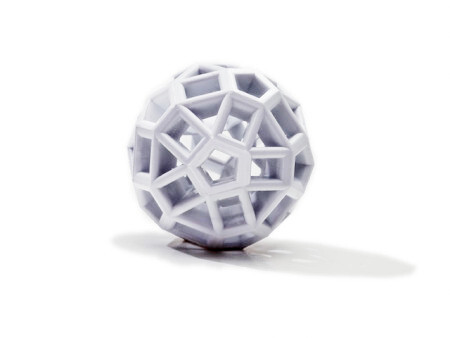
Most people see a "fancy Tinkertoy." Engineers see a miracle. To achieve the "31-zone system" that allows you to build everything from DNA to 4D hyperspace, our nodes require a tolerance of ±0.01mm. That’s thinner than a human hair.
3D printing? Too crude. 3D printers are 10x less precise than what Zometool requires.
The Secret: Our hollow, one-piece ball is produced by a legendary hydraulic mold. It was built and produced the first ball on April 1st, 1992 (No joke!). It has been called "the most advanced tool ever built" in the manufacturing world.
The Math of Beauty
The part that "designed itself"
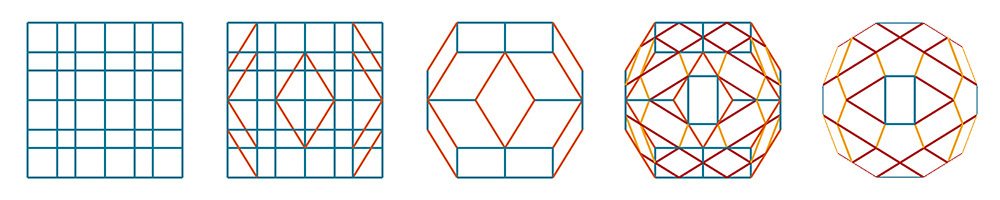
The Zome ball wasn’t "sketched", it was discovered. Using Steve Baer’s 31-zone system and the Divine Proportion (The Golden Ratio), Marc Pelletier drew the first ball using a Divine Proportion “graph paper” that Baer suggested (above), and Steve Rogers built a 6’ diameter model of it using Baer’s Zometoy. It took over a decade of work to produce the first ball.
The result? A rhombicosidodecahedron (try saying that three times fast) that acts as a universal translator for the shapes of nature.
One node, unlimited possibilities
From atomic bonds to the Structure of Space
Why do Nobel Prize winners and 8-year-olds use the same ball? Because the Zometool node models the very stuff you—and the world around you—are made of. Most people think the Zometool is a fancy Tinkertoy, or molecular modeling tool. It is oh-so-much more.
The Material: Our balls are made of high-quality ABS plastic, the same stuff Lego is made of (But try building THIS with Lego: a molecular model of ABS itself!)

The Blueprint of Life: Whether it’s a DNA double-helix or a complex quasicrystal, the node provides the perfect geometric framework for the universe’s most complex structures.